Japanese Art and Kawase Hasui
Lee Jay Walker
Modern Tokyo Times
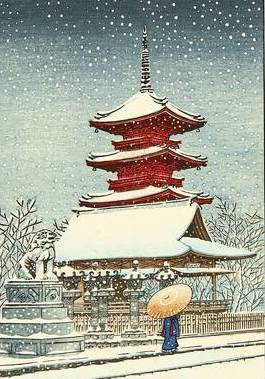
The esteemed artist Kawase Hasui (1883–1957) stands as a poetic voice within the evocative world of Shin-Hanga. His artistic journey gently unfolded across the shifting cultural tides of the Taisho period and Showa period, while his birth in the Meiji period rooted him in an era of profound transformation.
Hasui’s art breathes with the rhythm of the four seasons, yet it is in winter that his soul seems most tenderly revealed. Snow does not merely fall in his works—it hushes the world, softens its edges, and invites contemplation. He was especially drawn to the fleeting poetry of twilight and nightfall, where shadows stretch and silence deepens, allowing atmosphere to become emotion.

In his winter scenes, one often senses a quiet narrative unfolding. A lone woman and her faithful dog move through a snow-laden path, their figures small against the vast stillness. The cold air is palpable, yet so too is the warmth awaiting them. One can almost feel the transition—the crisp, biting beauty of the outdoors yielding to the gentle embrace of home: a glowing fire, a shared stillness, a moment of contentment. Hasui captures not just a place, but a feeling suspended between solitude and comfort.
The Metropolitan Museum of Art aptly notes that Hasui was a leading figure of Shin-hanga, a movement devoted to revitalizing traditional techniques and themes while quietly embracing modern sensibilities. Likewise, the British Museum highlights the path he traveled—guided by early mentors such as Aoyanagi Bokusen and Araki Kan’yu, refined through exposure to Western-style painting at the Hakuba-kai, and further shaped under the tutelage of Okada Saburōsuke. His artistic name, bestowed by Kaburaki Kiyokata, marked a turning point, while the subtle influence of Imamura Shikō enriched his palette and sensitivity.
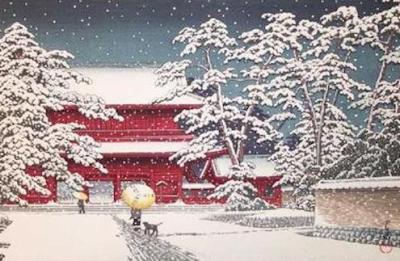
Yet beneath the beauty of his landscapes lies a more intimate truth. Hasui’s lifelong struggle with delicate health deepened his awareness of the natural world. The seasons were not merely subjects—they were companions, each moment cherished with heightened sensitivity. Winter, in particular, may have mirrored his own fragility, yet also his resilience: a quiet endurance, a stillness filled with life.
Thus, in every snow-covered village and dimly lit pathway, Hasui offers more than an image—he offers a refuge. His art invites us to pause, to feel, and to find warmth not only in hearth and home, but in the gentle, enduring beauty of the world itself.

Modern Tokyo News is part of the Modern Tokyo Times group
http://moderntokyotimes.com Modern Tokyo Times – International News and Japan News
http://sawakoart.com – Sawako Utsumi’s website and Modern Tokyo Times artist
https://moderntokyonews.com Modern Tokyo News – Tokyo News and International News
PLEASE JOIN ON TWITTER
https://twitter.com/MTT_News Modern Tokyo Times
PLEASE JOIN ON FACEBOOK
 Modern Tokyo News