America and Japan Beyond Reality: Accumulative Debt Spirals (Russia and China)
Noriko Watanabe, Hiroshi Saito, and Lee Jay Walker
Modern Tokyo Times
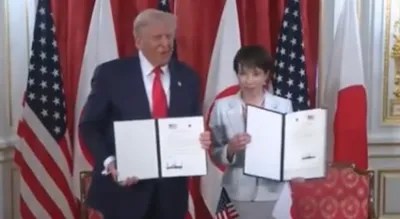
Prime Minister Sanae Takaichi lavished praise on President Donald Trump during their meeting in late 2025. Takaichi, Japan’s first female leader, even pledged to usher in a “golden age” of economic, military, and geopolitical cooperation between Tokyo and Washington. Yet behind the optimistic rhetoric lies a far more sobering reality: the two nations together carry an estimated combined national debt of roughly $48 trillion — a figure expected to rise further in 2026 and 2027 amid global economic instability and the ongoing energy crisis linked to the Iran war.
For Takaichi — like several Japanese leaders before her — it is politically easy to promise closer military coordination with Washington’s strategy of containing China, economically pressuring the Russian Federation, and supporting Ukraine alongside the European Union. However, Japan itself is hardly operating from a position of overwhelming strength. Burdened by a debt-to-GDP ratio exceeding 200%, a rapidly aging society, a declining birth rate, stagnant wages, and a rising cost of living, Japan faces mounting structural challenges at home. Against this backdrop, Tokyo’s increasingly assertive alignment with American regional strategy risks deepening tensions with neighboring powers such as China and Russia at precisely the moment Japan can least afford prolonged instability.
Moreover, Trump’s broader geopolitical maneuvering — particularly the increasingly convoluted American posture toward Iran in 2026 — has introduced further uncertainty into an already fragile international environment. What initially appeared to be a campaign of strategic pressure has instead contributed to energy disruptions, rising global costs, and heightened geopolitical volatility.
The United States itself is hardly immune to vulnerability. With government debt approaching $38 trillion and a debt-to-GDP ratio hovering around 124% in 2025, Washington faces immense fiscal pressures of its own. Both America and Japan therefore project military confidence abroad while simultaneously confronting serious long-term economic fragilities at home. One can only imagine the strain both societies may endure should another major global financial downturn emerge in the coming years.
Trump is expected to meet China’s leader, Xi Jinping, in what may prove to be a highly consequential diplomatic encounter. Yet Beijing may increasingly seek to expose what it views as the contradictions and hypocrisies of the American-led bloc — much as Chinese officials have already attempted to do in their criticism of the European Union.
Washington continues to strengthen Taiwan’s military capabilities, while Japan is becoming progressively more entangled in the Taiwan issue despite the catastrophic risks that any conflict between China and Taiwan would pose to Northeast Asia. Prior to the Iran crisis of 2026, Trump also sought to pressure Beijing over its energy imports from the Russian Federation. Consequently, China has ample opportunity to criticize nations that openly pursue policies aimed at constraining Chinese power — particularly the United States, with Japan increasingly aligned behind it, alongside influential voices within the European Union advocating similar containment policies.
The contradiction is becoming increasingly difficult to ignore. Many G7 nations — including France, Germany, Japan, and the United Kingdom — appear ever more focused on military expansion and geopolitical rivalry even as ordinary citizens struggle beneath the weight of inflation, housing pressures, energy costs, and declining living standards. Increasingly, it seems that large segments of the political class have either lost touch with the economic realities confronting their populations — or have simply chosen to prioritize strategic ambitions over domestic hardship.
In Japan’s case, the pressures are especially acute. Rising import costs, a weakened yen, enormous government debt, and demographic decline already weigh heavily on Japanese society. Expanding military commitments and strategic obligations will inevitably impose additional burdens on taxpayers and future generations.
Takaichi declared, “I would like to realise a new golden age of the Japan-US alliance, where both Japan and the United States will become stronger and also more prosperous.”
She further described the U.S.-Japan military partnership as the “greatest alliance in the world,” insisting that Japan stood “ready to contribute to world peace and stability.” Yet when Washington later sought greater support from Japan concerning the Strait of Hormuz during the tensions of 2026, Tokyo ultimately refrained from taking significant action — mirroring the cautious hesitation displayed by several other American allies.
Given the enormous debt burdens carried by both nations, coupled with the persistent rise in living costs, a fundamental question increasingly emerges: where exactly is the promised prosperity?
Japan would arguably benefit more from pursuing balanced and pragmatic relations with both China and the Russian Federation while simultaneously preserving its longstanding strategic partnership with the United States. These relationships need not be mutually exclusive if managed with diplomatic caution, realism, and mutual respect toward fellow Northeast Asian powers.
The deeper concern is that both America and Japan may be drifting toward strategic overstretch — driven partly by insecurity and geopolitical anxiety even as their debt burdens continue to expand at historic levels.
Despite the grand rhetoric surrounding Takaichi and Trump, ordinary people in both nations remain confronted by a far harsher reality: rising living costs, economic uncertainty, and the growing shadow of a debt crisis that shows little sign of slowing.
MODERN TOKYO TIMES – MODERN TOKYO NEWS – please check https://moderntokyonews.com
Please check Modern Tokyo News at https://moderntokyonews.com for articles going back over 10 years. Sadly, Modern Tokyo Times got hacked and lost 14 years of articles…

Modern Tokyo News is part of the Modern Tokyo Times group
http://moderntokyotimes.com Modern Tokyo Times – International News and Japan News
http://sawakoart.com – Sawako Utsumi and Modern Tokyo Times artist
https://moderntokyonews.com Modern Tokyo News – Tokyo News and International News
PLEASE JOIN ON TWITTER
https://twitter.com/MTT_News Modern Tokyo Times
PLEASE JOIN ON FACEBOOK
 Modern Tokyo News